By Fredrik Lindstrom · ~7 minute read · September 2026
On Saturday, 12 September, Anthropic CEO Dario Amodei published a proposal calling for a more deliberate pace of AI development. Sam Altman, Elon Musk, Demis Hassabis and Satya Nadella soon voiced their agreement.
The pushback came just as fast. Meta CEO Mark Zuckerberg has rejected a coordinated slowdown. Former White House AI adviser David Sacks called the proposal regulatory capture, meaning rules that favor the companies helping write them, and dared the labs to slow down voluntarily. House Speaker Mike Johnson framed it as a threat to the race with China. Palantir’s Alex Karp and Shyam Sankar asked whether the warnings are sincere or a sales pitch. Writer Brian Merchant argued the plan mainly serves Anthropic and OpenAI. And the rival CEOs who endorsed it have not, so far, slowed a single release.
Real safety concern or clever positioning, the coverage keeps circling one question: what happens to AI if the frontier stops moving?
After 25 years in enterprise technology, I think the answer is less dramatic than either side suggests. For most organizations, almost nothing changes. They were never running at the frontier.
The capability nobody is using
In my experience, very few companies use AI anywhere near its current capability. Many still hold to the same plan: clean the data first, bring in AI after.
On Tuesday evening, three days after Dario Amodei’s slowdown essay, Scott Riley told a room of founders at a Momentum Partners Exchange evening in Tampa what that plan costs. Scott is the former CEO of Fintech, the alcohol-industry payments company he took from zero to more than $30 billion in payments. McKinsey quoted his company $3M and two years to clean its data. He hired four interns and one data scientist instead. They finished in less than a year, for a fraction of the quote.
The McKinsey quote assumed data quality is a gate you clear before the real work starts. Scott treated it as work you staff and run. That was my argument in AI Doesn’t Need Perfect Data in August. Cleanup never ends, so you manage it as a rate, and today’s models can do much of the work Scott gave his interns.
Cybersecurity went through this exactly. Organizations bought security platforms, deployed a fraction of the features, and then asked for the next product. The gap was never the technology. It was the people and the process around it. AI is following the same arc, and the unused capability inside today’s models is larger than anything the next release will add.
The AI build-out already paid for
A freeze would also matter less than the headlines suggest. According to Bessemer Venture Partners, a data center takes 12 to 18 months to build and five to seven years to connect to the grid. The data centers and power contracts being committed right now arrive whether or not the labs ship a new model in the meantime.
Take the extreme case. Every lab stops training tomorrow. Compute still gets cheaper and more plentiful every year until the end of the decade. Inference costs fall. Tools built on today’s models mature. Companies that spent 2026 arguing about data readiness finally deploy. Even with frozen models, we will do far more in 2029 than we do today.
Time does not stop: Qwen 3.6 27B vs Qwen 3.8 27B
Of course, nobody is actually freezing anything. Not even the CEOs who signed on. Watch what happened at the small end of the market this summer.
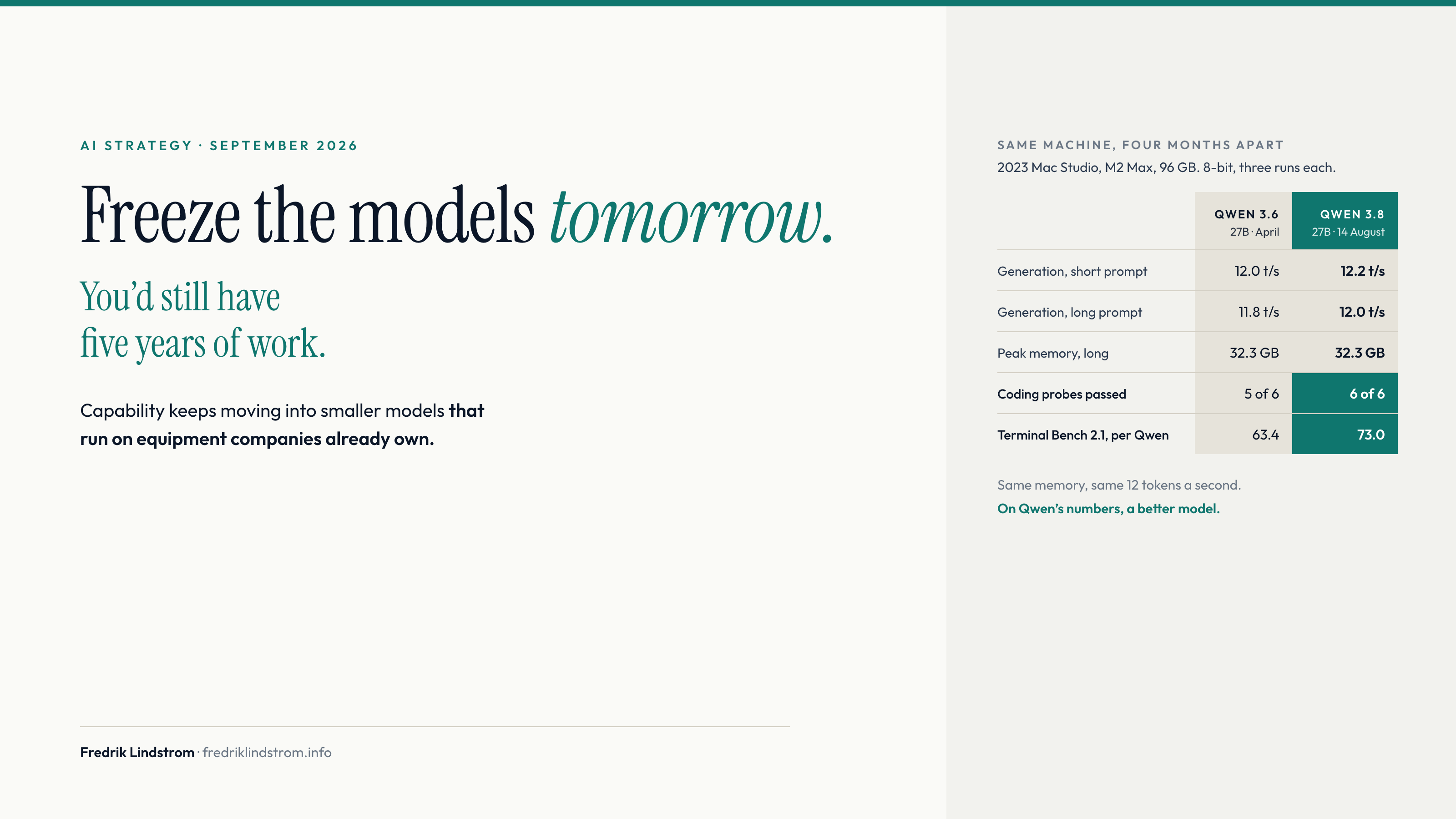
Alibaba’s Qwen team shipped Qwen 3.6 27B in April. Qwen 3.8 27B followed on 14 August: same 27 billion parameters, same architecture, same 262K context window, same Apache 2.0 license. On Terminal Bench 2.1, the agentic coding benchmark Qwen reports, the score rose from 63.4 to 73.0. The 4-bit build is a 17 GB file; the 8-bit build I ran is 28 GB.
I tested Qwen 3.6 27B and Qwen 3.8 27B on the Mac Studio I bought in 2023, an M2 Max with 96 GB of memory. Same 8-bit quantization, same prompts, greedy decoding, three timed runs each, with a short prompt and a 6,187-token one.
| Qwen 3.6 27B | Qwen 3.8 27B | |
|---|---|---|
| Generation, short prompt | 12.0 t/s | 12.2 t/s |
| Generation, 6,187-token prompt | 11.8 t/s | 12.0 t/s |
| Prompt processing, long | 143 t/s | 146 t/s |
| Time to first token, long | 43.3 s | 42.6 s |
| Peak memory (short / long) | 28.9 / 32.3 GB | 28.9 / 32.3 GB |
| Coding probes passed | 5 of 6 | 6 of 6 |
Every performance line moved by less than three percent, and memory didn’t move at all. On the coding probes, Qwen 3.6 missed one: an interval-merge spec it read differently, and defensibly. Small sample.
As Simon Willison put it after testing the new model, “We don’t need to spend half a million dollars on datacenter-class hardware.”
Four months. Same machine, same memory, same 12 tokens a second. On Qwen’s numbers, a better model, and nobody bought new hardware to get it.
That is what a slowdown at the frontier leaves untouched. Capability keeps moving down into smaller, cheaper models that run on equipment companies already own. The same holds for the long-running argument about whether large language models lead to AGI or ASI. Maybe they don’t. It barely matters for the decision in front of a board this quarter. We have spent not quite four years exploring what LLMs can do, and that is an early chapter.
What to do on Monday
If you sit on a board or run a business, the AI slowdown debate is worth following and not worth waiting on. The frontier can pause. Your competitors’ adoption curve will not. So stop asking where AI is going and start asking what it can do for you this quarter. Here is the sequence I would use.
1. Start with the outcome. Name the business problem or the result you are paying for: the backlog you want gone, or the decision that takes three weeks and should take three hours. Don’t start with the model or the data, and don’t start with the vendor demo.
2. Work with what you have. The data you have today is the data you’ll have when the cleanup project finishes, plus two years of new errors. Start there.
3. Build the system that manages data quality as you go. Let AI fix what it can, and design the escalation path for what it can’t, so a person decides where the model should stop. This takes staffing, and it runs in cycles. Scott Riley didn’t buy a cleanup. He hired four interns and a data scientist and ran it as ongoing work.
4. Scale it, then pick the next outcome. The first system teaches you what the second one needs. By the third, you have the data inventory the consultants wanted to charge you two years for.
And if someone in the room says “data first,” kindly walk them to the door and close it behind them. It’s the most valuable thing you’ll do all week.
If you’re stuck on step one, or your team keeps landing back at “clean the data first,” I can help. I work with boards and leadership teams on exactly this problem. Get in touch.