By Fredrik Lindstrom · ~10 minute read · May 2026
Update, October 14, 2026: The original treated August 2, 2026 as the EU AI Act Article 4 enforcement deadline and put the €35 million or 7% penalty ceiling beside it. Article 4 AI literacy has applied since February 2, 2025, and it has no fine tier of its own; the 7% ceiling is for prohibited practices. The 2026 Digital Omnibus has since softened Article 4 to a duty to support AI literacy. The text is corrected below.
Executive Summary
- The promise is real. Capability is improving faster than any prior technology wave. Stanford HAI’s 2026 AI Index reports $172 billion in annual consumer value from generative AI tools, with 53% global population adoption in three years — faster than the PC or the internet. The augment phase itself produces measurable engineering and customer-service wins today. None of this is in dispute.
- The risk is mistaking trajectory for present-day capability. The fire-then-quietly-rehire pattern is documented. Klarna reversed May 2025. CBA reversed August 2025. Forrester forecasts half of AI-attributed layoffs will be quietly reversed at lower pay. Gartner forecasts 50% of companies cutting customer-service staff citing AI will rehire by 2027.
- The capability snapshot does not support wholesale replacement in judgment-bearing work. Carnegie Mellon’s TheAgentCompany benchmark (December 2024): top AI completes 24% of office tasks. MIT NANDA (July 2025): 95% of enterprise GenAI pilots produced no measurable P&L despite $30 to $40 billion spent.
- The governance exposure compounds. Delaware Caremark doctrine, EU AI Act Article 4 (applying since February 2, 2025), SEC AI-washing enforcement (Delphia and Global Predictions, March 2024). Deloitte 2025: 66% of directors describe their boards as having limited to no AI knowledge.
- The right sequence is augment, validate, consolidate, redeploy — with each step sharpened. Validate against capability trajectory, not snapshot. Define the quality bar as cost-acceptable use-case fit, not human equivalence across all failure modes. Redesign the workflow when you consolidate; don’t bolt AI onto the old one. Be honest about where redeployment leads. Done badly, this sequence becomes lay off slower with better optics. Done well, it is the only path that survives Delaware, the EU, and the SEC.
The pattern
On February 26, 2026, Jack Dorsey cut 4,000 people from Block. Roughly 40% of the workforce. The headlines called it AI-driven restructuring. Dorsey himself said on X the cuts were because he had “over-hired during covid because I incorrectly built 2 separate company structures.” Two stories. One layoff. The market chose the AI one. The stock surged 24%.
This is the pattern. Companies announce AI-driven workforce reductions, the market rewards the narrative, and within twelve months half of them are quietly rehiring — usually offshore, usually at lower salaries, usually without a press release. Gartner forecast on February 3, 2026 that 50% of companies cutting customer-service staff citing AI will rehire by 2027. Forrester put it more directly in its Predictions 2026 report: when CEOs announcing AI-driven layoffs were asked whether mature AI was actually in place at the time of the cuts, the answer was no nine times out of ten.
The question this puts on a board agenda is not whether AI will eventually change knowledge work. It will. The question is what directors are approving right now, against what evidence, with what oversight, and what fiduciary exposure they are accepting along the way.
What’s working
The promise is not in dispute. Stanford HAI’s 2026 AI Index reported $172 billion in annual consumer value generated by generative AI tools in early 2026, with 53% global population adoption in three years — faster than the PC and the internet. Anthropic’s annual revenue run rate is set to reach $50 billion by mid-2026. Global corporate AI investment hit $581.7 billion in 2025, up 130% year over year. McKinsey reports that high performers using AI are 2.8 times more likely to have redesigned workflows around it.
The augment phase itself produces measurable wins. Engineering teams using AI code assistance consistently report 20–30% velocity improvements on bounded tasks. Customer-service agents with AI co-pilots resolve calls faster and escalate less often than agents working alone. Document review, contract analysis, and structured data extraction are areas where AI is already production-grade in narrow configurations and routinely outperforms unaugmented humans on cost and speed.
And the trajectory is real. The 24% completion ceiling on TheAgentCompany benchmark in December 2024 became 30.3% within months. The capability gap between frontier models and the prior generation closes every six to twelve months. The companies that have bet against AI capability improving have lost that bet for fifteen years running.
If the article ended here, this would be a Promise piece. It does not end here, because the governance question is not whether the trajectory exists. It is whether the boards approving today’s workforce actions are reading the trajectory correctly — and whether the legal architecture lets them act on trajectory rather than on current state.
What the capability data actually shows
In December 2024, researchers at Carnegie Mellon and Salesforce published TheAgentCompany benchmark. They built a simulated company environment and asked the top AI models to complete real office tasks across HR, finance, engineering, and operations. The best model at the time, Anthropic’s Claude 3.5 Sonnet, completed 24% of assigned tasks. Gemini 2.0 Flash hit 11.4%. GPT-4, 8.6%. Amazon Nova Pro, 1.7%. Eighteen months later the ceiling has moved, but it has not crossed the threshold for wholesale replacement in judgment-bearing work.
MIT’s NANDA initiative published The GenAI Divide: State of AI in Business 2025 in July 2025. The headline finding: 95% of enterprise GenAI pilots produced no measurable P&L impact despite an estimated $30 to $40 billion in spending. McKinsey’s State of AI 2025, published in November, reported that 88% of organizations use AI in at least one function, but only 39% can point to EBIT impact, and only 23% are scaling AI agents beyond pilot. Sixteen percent reported negative ROI on AI projects last year, according to the Globalization Partners third annual AI at Work study released in May 2026.
The Klarna case is instructive. In 2022, the company began cutting customer-service roles and replacing them with a chatbot. The CEO publicly claimed it was doing the work of 700 agents. By May 8, 2025, Sebastian Siemiatkowski reversed course in a Bloomberg interview:
“As cost unfortunately seems to have been a too predominant evaluation factor when organizing this, what you end up having is lower quality.”
— Sebastian Siemiatkowski, Klarna CEO, Bloomberg, May 8, 2025
The Commonwealth Bank of Australia’s reversal in August 2025 was more direct. A union tribunal forced disclosure that “CBA’s initial assessment that the 45 roles in our Customer Service Direct business were not required did not adequately consider all relevant business considerations and this error meant the roles were not redundant.”
Two companies. Two different jurisdictions. Same failure mode. Both companies cut against capability that was below their declared quality bar, and both paid for it inside twelve months.
Where the governance exposure compounds
The Delaware case law on board oversight already covers AI workforce decisions. Caremark (1996) requires boards to make a good-faith effort to maintain reasonable monitoring systems. Marchand v. Barnhill (2019) raised the bar for mission-critical operations. In re McDonald’s (2023) extended these duties to executive officers. Harvard’s Ethics Center and Oxford Law Blogs have both published analyses in 2025 and 2026 applying Caremark explicitly to AI deployments where the technology is core to operations. Customer-service automation that fails publicly is exactly the kind of incident that triggers second-prong review.
The SEC has already moved. On March 18, 2024, the agency settled AI-washing charges against Delphia and Global Predictions for a combined $400,000. Chair Gensler stated plainly that AI washing may violate the securities laws. The Stanford Securities Class Action Clearinghouse tracks 41 AI-related class actions since March 2020, with 15 filed in 2024 alone. While no SEC case has yet been brought tied specifically to a workforce announcement, the architecture is there. Oxford Economics Director of Global Macro Research Ben May named the disclosure risk directly in a January 2026 report:
“We suspect some firms are trying to dress up layoffs as a good news story rather than a bad one. For example, by pointing to technological change instead of past overhiring.”
— Ben May, Oxford Economics, January 2026
In Europe, EU AI Act Article 4 has required AI literacy across organizations that use AI inside the EU since February 2, 2025. The 2026 Digital Omnibus softened it to a duty to support AI literacy, which makes it a duty of effort, judged on the record a company can produce. Article 4 carries no fine tier of its own. A company that cut human headcount and has no record of building the remaining staff’s ability to oversee the AI is exposed on two sides at once.
And the boards approving these decisions are largely unprepared. Deloitte’s Governance of AI (2nd edition, 2025), surveying 695 board members and C-suite executives across 56 countries, found that 66% of directors describe their boards as having limited to no knowledge or experience with AI.
The right sequence
After 25 years in cybersecurity, I have watched this pattern across cloud, mobile, data, and now AI. The companies that build governance in parallel with deployment win. But the cyber analogy needs precision. The auto-response camp (SOAR, XDR, behavior-based detection) won speed at the cost of false-positive tolerance. The augment-analyst camp built deeper expertise at the cost of slower response. The winners did both, sequenced correctly: augment first to build the institutional knowledge of what the system actually does, then automate the parts where the cost of error became acceptable.
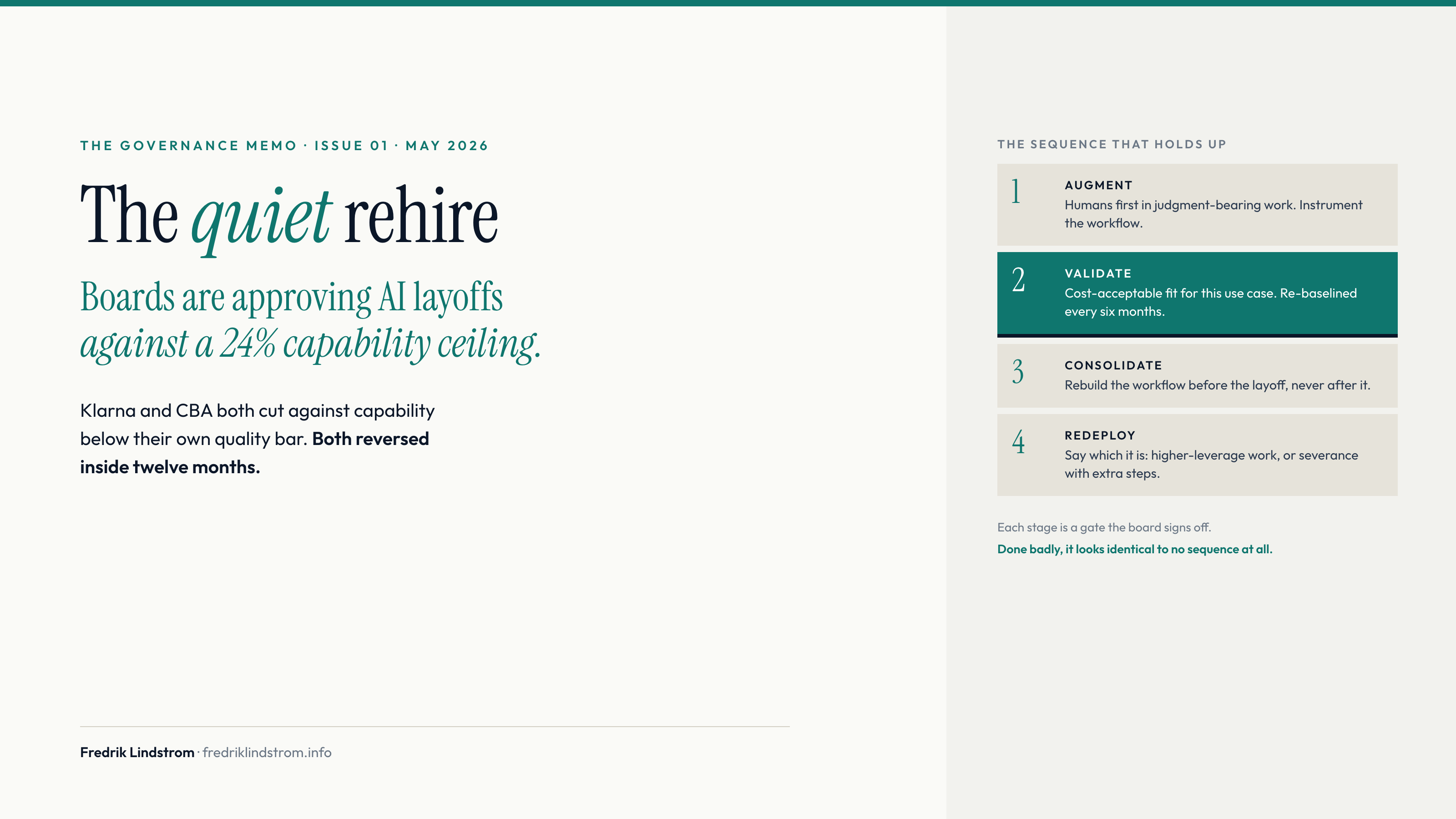
That sequence translates to AI workforce decisions as four stages. Each one has a sharper version that addresses the failure modes companies have actually hit in 2024 and 2025.
Augment. Humans first, especially in judgment-bearing or regulated workflows. Customer service, hiring, lending, healthcare diagnostics, customer-facing communications. These are not the places to start with replacement. Engineering velocity, draft-and-review, document classification, structured extraction. These are. The line between the two is whether the failure modes compound reputationally or legally. The augment phase exists to instrument the workflow, not to delay the decision.
Validate. Against two bars simultaneously, not one. First bar: cost-acceptable use-case fit. The honest question is not “is the AI as good as a senior agent on a good day?” The honest question is “is the AI good enough at acceptable cost for this specific use case, including the cost of the failure modes?” Klarna’s failure was not that the AI was worse than humans across every dimension. It was that the cost of the failure modes (escalation rate, customer churn, regulatory complaint volume) exceeded the cost savings. Second bar: capability trajectory. Re-baseline every six months. A validation done against December 2024 capability and not refreshed is governance theater. Build the re-baseline cadence into the board agenda.
Consolidate. With workflow redesign, not bolt-on automation. This is where the Innovator’s Dilemma critique lands hardest. Augment-first done badly preserves the old workflow with AI duct-taped onto it, and the augment-first crowd loses to disruptors who rebuilt the workflow from the ground up. Augment-first done well uses the augmentation phase to learn what the new workflow should look like, and then rebuilds. Klarna kept the human-shaped customer-service workflow and replaced humans with a chatbot inside it. The workflow itself was the wrong shape for AI. The rebuild has to come before the consolidation, not after the layoff.
Redeploy. Honestly. This is the step that produces the cynical reading of the sequence. “Augment-validate-consolidate-redeploy” can sound like “lay off slower with better optics.” That risk is real. The honest version: most enterprises do not have eighteen months of higher-leverage work waiting for the people they consolidate out of a workflow. Some do, in which case redeployment is genuine. Many don’t, in which case redeployment is severance with extra steps. Either is defensible. Neither is what most companies are claiming. Boards should require management to specify which version applies before approving the consolidation, and the disclosure language has to be consistent across the press release, the board minutes, and the all-hands. Inconsistency is what attracts SEC attention.
On balance, the sequence works, but only for organizations that treat each of the four stages as a discrete governance gate, not a slide title. The risk is not that the sequence is wrong. The risk is that the sequence done badly looks identical to no sequence at all, and produces the same rehiring outcome eighteen months later, with one extra year of legal exposure and lost institutional knowledge stacked on top.
The cost of getting the sequence wrong
The promise is real. The trajectory is real. The capability gap between frontier models and last generation closes every six to twelve months. None of that is in dispute. What is in dispute is whether the boards approving today’s headcount actions are reading the trajectory correctly, and whether the legal, regulatory, and disclosure architecture lets them act on trajectory rather than on current state. As of May 2026, the answer to the second question is no. Delaware says no. The EU says no through Article 4. The SEC has the precedent built and is one workforce case away from saying no.
The companies treating governance as a precondition for ROI, not a parallel workstream to get to later, will be the ones that compound. The ones cutting first and validating later are about to discover, in compressed timeline, that governance debt and technical debt behave the same way. They don’t go away. They get more expensive.
The boomerang is no longer a prediction. Klarna, CBA, Duolingo. Forrester’s quiet-rehire forecast. Gartner’s 2027 timeline. The Carnegie Mellon ceiling. The MIT P&L data. The four Delaware oversight cases. The EU’s Article 4 literacy duty.
The boards that read the data correctly will redeploy people after they have proved the workflow can be consolidated. The boards that read the headlines will redeploy people first and rehire them six months later. One of those routes preserves credibility, institutional knowledge, and shareholder value. The other one shows up in proxy statements.
Fredrik Lindstrom advises boards and executives on AI governance and cyber risk, and takes fractional CIO, CISO and Chief AI Officer seats. He spent 25 years in cybersecurity, most recently running global services sales at Check Point Software, and hosts the Promise & Risk of AI channel.