Resource
A pause is not a defect. Ask who designed it.
Every buyer's checklist doing the rounds this year grades agents on one axis: does it keep going without being re-prompted. That reads a designed halt and a capability gap as the same failure. They are opposites.
A pause you designed is a control. A pause because the build ran out of road is a gap. Score an agent on capability alone and the highest score goes to the one nobody can stop.
The matrix below adds the axis those checklists leave off. Autonomy between decisions runs left to right. Halt authority — whether a named person can stop the agent before it does something binding — runs bottom to top.
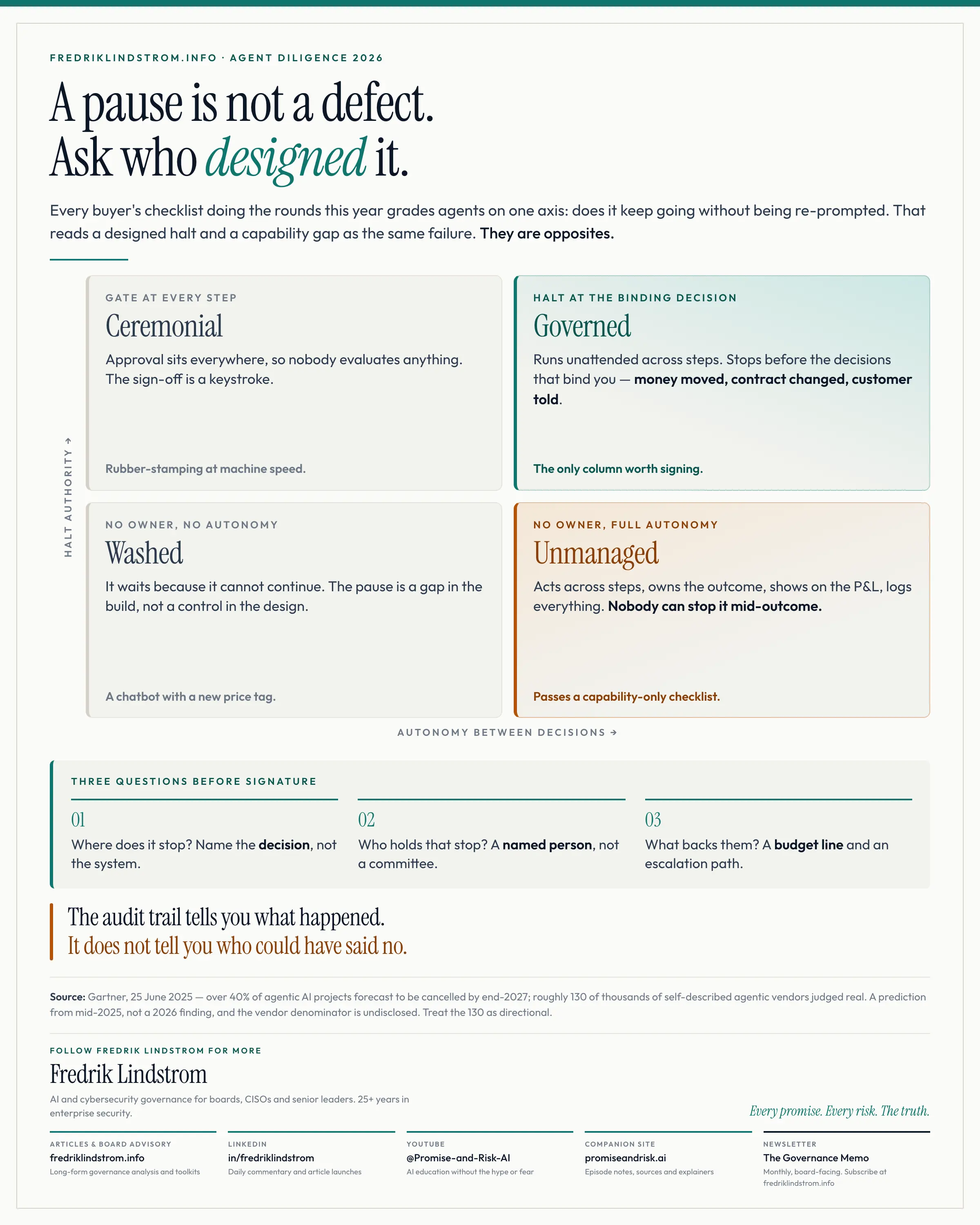
The four quadrants
The answer The warning
-
Gate at every step
Ceremonial
Approval sits everywhere, so nobody evaluates anything. The sign-off is a keystroke.
Rubber-stamping at machine speed.
-
Halt at the binding decision
Governed
Runs unattended across steps. Stops before the decisions that bind you — money moved, contract changed, customer told.
The only column worth signing.
-
No owner, no autonomy
Washed
It waits because it cannot continue. The pause is a gap in the build, not a control in the design.
A chatbot with a new price tag.
-
No owner, full autonomy
Unmanaged
Acts across steps, owns the outcome, shows on the P&L, logs everything. Nobody can stop it mid-outcome.
Passes a capability-only checklist.
The load-bearing quadrant is Unmanaged. An agent can pass a capability-only checklist in full — acting across steps, owning an outcome, never needing a re-prompt — and still be one nobody can stop mid-outcome. Capability and control are separate questions. Only one of them is on most checklists.
Three questions before signature
- 01
Where does it stop?
Name the decision, not the system.
- 02
Who holds that stop?
A named person, not a committee.
- 03
What backs them?
A budget line and an escalation path.
The audit trail tells you what happened. It does not tell you who could have said no.
Source: Gartner, 25 June 2025 — over 40% of agentic AI projects forecast to be cancelled by end-2027; roughly 130 of thousands of self-described agentic vendors judged real. A prediction from mid-2025, not a 2026 finding, and the vendor denominator is undisclosed. Treat the 130 as directional.
Related
What each AI tier actually decides — regulatory exposure tracked against the consequence of the decision, with the reversibility column most charts leave off.
What AI actually contains — a corrected taxonomy of the capability stack, and why agents are an architecture rather than a stage of intelligence.
The Governance Memo carries this work monthly for boards and CISOs — one breach post-mortem and two or three governance items.