By Fredrik Lindstrom · ~8 minute read · July 2026
Framtidsfabriken floated on the Stockholm exchange in 1999 at 125 kronor a share (about €15 or $14 at the time). At its peak, Framfab was worth 42 billion kronor (roughly €5 billion or $4.6 billion), in the same neighborhood as Atlas Copco and SKF, two of Sweden’s industrial institutions. It was, for a stretch, the largest internet consultancy in Europe. By the spring of 2001 the share traded at 2 kronor (about €0.25 or $0.22) and the company was one rights issue away from bankruptcy.
I was on the consulting side for both halves of that arc. On the way up, we helped Framfab build out the infrastructure the growth story demanded. On the way down, we helped the same business shrink back to the size its actual revenue could support. The hands that wired the build-out helped unwind it. New leadership in the room. Decisions measured against a profit-and-loss statement instead of a share price. The founder, Jonas Birgersson, said it cleanly years later: the bet that the internet would matter was correct. Pricing a 3,000-person consultancy at 42 billion kronor was not, and he knew it while it was happening.
I have been thinking about Framfab a lot lately, because the dominant theory of how to win at AI is the same theory that built that valuation. And it is wrong in the same way.
The theory has a name in the more online corners of the field: tokenmaxxing. Strip the slang and it says this. The way to win with AI is to spend more on compute. Push more tokens through the cloud APIs. Run your own GPUs at a hundred percent utilization, every hour of every day, because an idle GPU is wasted money and a wasted race. More compute in, more winning out. Spend more, win more.
It is seductive because it is simple, it is measurable, and it feels like effort. It is also the most expensive misunderstanding in the industry right now.
The belief has two versions
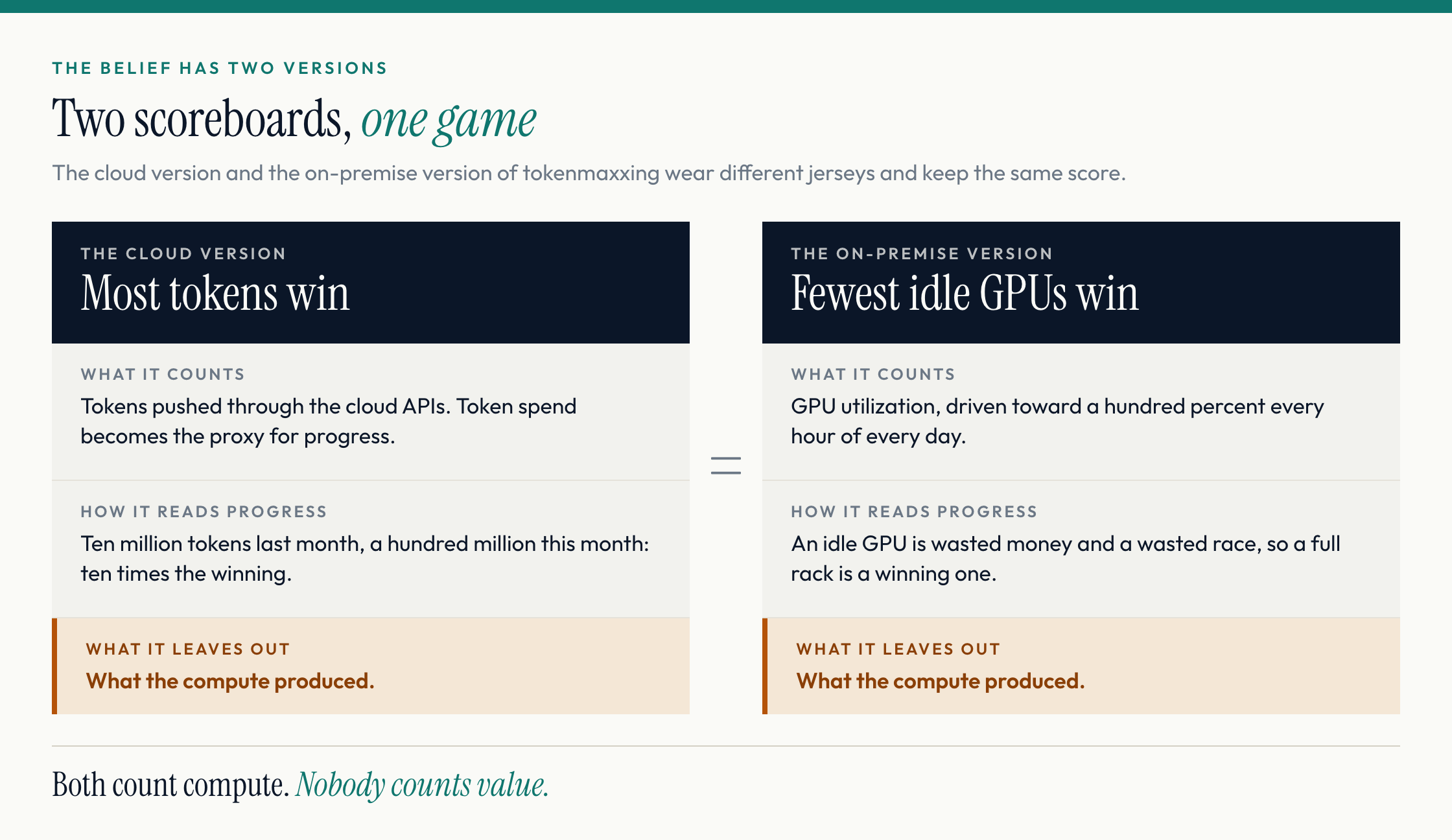
The first version lives in the cloud. Burn more tokens, the thinking goes, and you are extracting more value from the model. Token spend becomes a proxy for progress. A team that ran ten million tokens last month and a hundred million this month must be winning ten times harder.
The second version lives on-premise, and it sounds more sophisticated. The bottleneck, this version argues, was never a GPU shortage. It was a GPU utilization disaster. Most organizations run their accelerators far below capacity, so the move is to drive utilization toward a hundred percent. Fewest idle GPUs wins.
Here is the problem. “Most tokens wins” and “fewest idle GPUs wins” are the same scoreboard wearing two different jerseys. Both count compute. Neither counts what the compute produced.
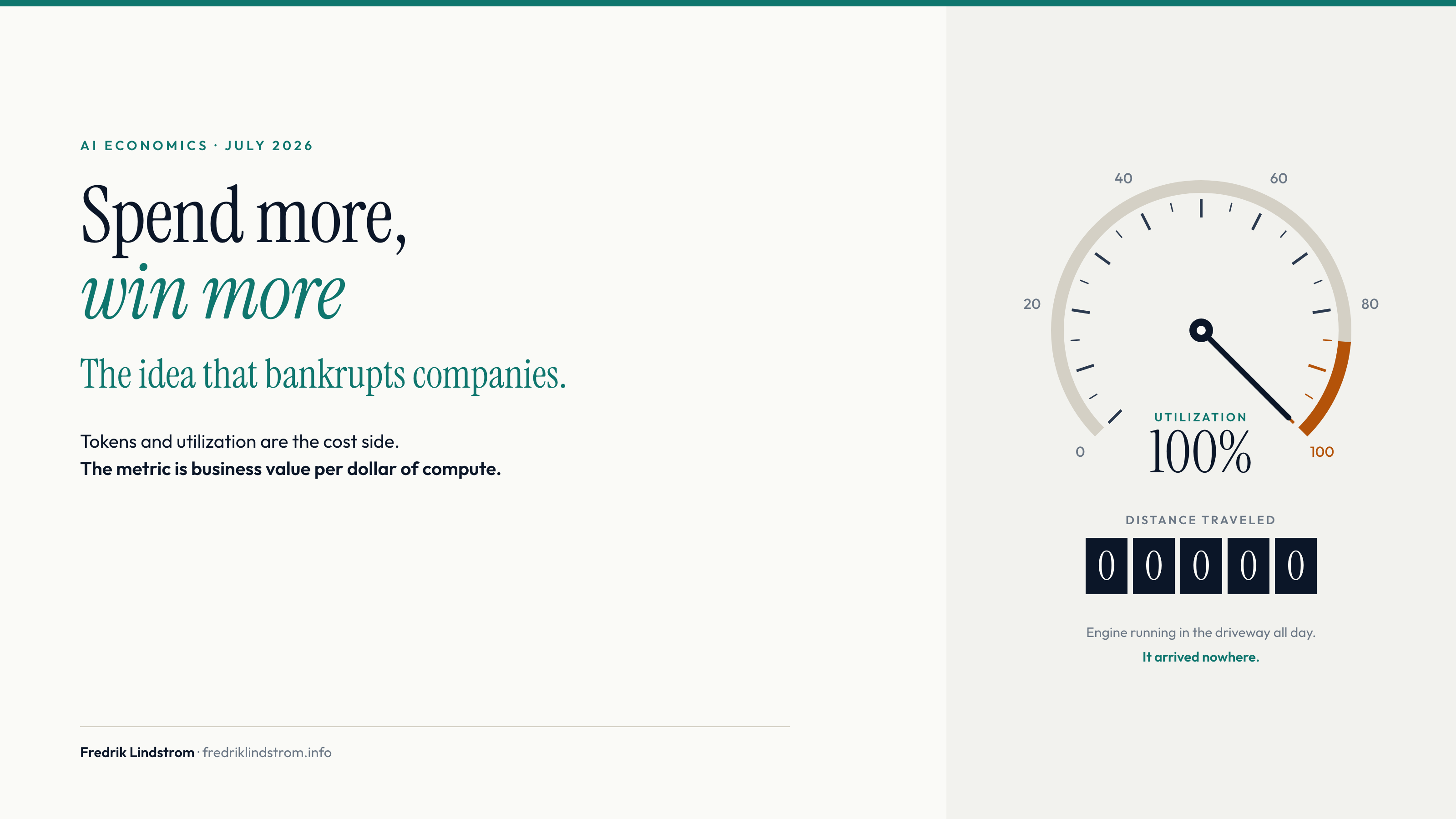
Think of the compute bill as fuel. Fuel burned is not distance traveled. You can leave the engine running in the driveway all day, gauge dropping, the tachometer pinned at a hundred percent, and arrive nowhere. Or you can spend the same tank driving to a customer who pays you. The win was never the fuel, and it was never how hard the engine ran. It was the destination. Max every card in the rack, burn through the API budget, ship nothing anyone will pay for, and you have a very efficient way of going nowhere.
The vendors have noticed the gap, and the response has been to repackage the same idea as “valuemaxxing,” usually meaning an orchestration layer that routes queries to right-sized models so cost stays flat while usage climbs. That is a real efficiency. It is not a strategy. A cheaper way to burn fuel still tells you nothing about where you are headed.
The leaderboard
This is not hypothetical, and you do not have to go back to 2000 to see it. In December 2025, Uber rolled Claude Code out across its engineering organization. Adoption climbed from 32 percent of engineers in February to 84 percent by March. The company ran an internal leaderboard that ranked teams by AI tool usage. By April, four months into the year, Uber had burned through its entire 2026 AI budget.
Then its own COO, Andrew Macdonald, told Fortune the part that matters. He could not draw a line between the rising tool use and useful features shipped to customers. “That link is not there yet,” he said.
Let that sink in; a company turned token consumption into a scoreboard, won the game it set for itself, and then could not say what it had bought. Amazon ran the same experiment. Its internal leaderboard, KiroRank, scored engineers on how much they used the company’s AI coding tool, until staff started pointing AI agents at needless tasks to climb it and the compute bill rose for work nobody needed. The senior executive who shut it down reached for the same word the rest of the internet uses: tokenmaxxing.
And these were not rogue employees gaming a system their bosses disliked. The bosses built the system. Meta’s CTO, Andrew Bosworth, pointed to his best engineer burning a full salary in tokens and getting up to ten times the output, and called it easy money with no reason to stop. Nvidia’s CEO, Jensen Huang, said he would be alarmed if an engineer earning $500,000 a year was not burning at least $250,000 in tokens. Databricks gathered its engineering team to applaud a developer who had spent $7,000 on tokens in two weeks. Tokenmaxxing is not a meme. It is doctrine, taught from the main stage.
The most extreme case is still unconfirmed. An AI consultant told Axios that one unnamed client ran up a 500-million-dollar bill in a single month after deploying the tool with no usage caps. That number is almost certainly an outlier. The pattern underneath it is not.
Notice what these companies did next. They did not abandon the tools. They capped them, retired the leaderboards, and started asking the value question they had skipped. Bosworth himself reversed course once Meta’s token bill climbed toward billions, telling staff to stop using AI for its own sake. The fix was never less AI. It was a better scoreboard.
I have seen this movie before
We did exactly this in cybersecurity for a decade. We counted tools deployed. We counted budget spent. We counted seats licensed and dashboards stood up, and we called the total “security posture.” Almost nobody asked the only question that mattered: what got prevented? Organizations with the largest security budgets were breached next to organizations spending a fraction as much, and leadership acted surprised. Spend was never the measure. Outcomes were. It took a generation of breaches landing in proxy statements before boards internalized the difference.
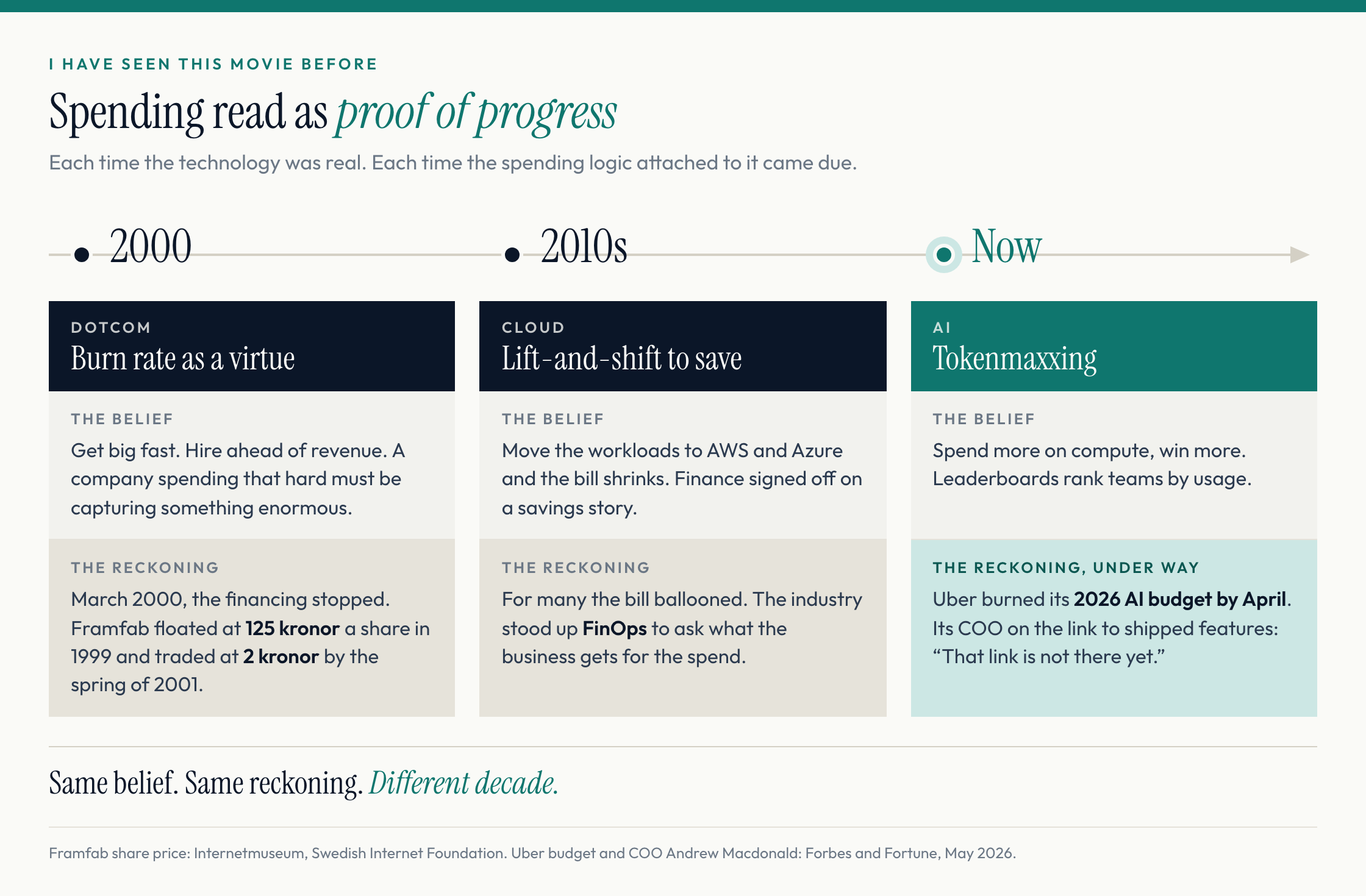
Then came cloud. In the 2010s, enterprises moved workloads to AWS and Azure expecting the bill to shrink, and for many it ballooned instead. Lift-and-shift relocated systems without rethinking them. Consumption pricing turned every over-provisioned server into a meter left running. Finance teams that had signed off on a savings story were handed an overspend, and the industry had to stand up a whole discipline, FinOps, to answer the question nobody had asked before signing the contract: what is the business getting for the spend? The companies that won the cloud era were never the ones with the biggest cloud bill. They were the ones who could tell you what each dollar of it ran.
The dotcom version was Framfab. In 1999 and 2000, burn rate was treated as a virtue. Get big fast. Hire ahead of revenue. Acquire competitors with stock everyone agreed was overvalued, including the people issuing it. The spending itself was read as the signal. A company spending that aggressively must be capturing something enormous. Then March 2000 arrived, the financing stopped, and every company whose model depended on the next round of capital discovered that compute, headcount, and office space are costs, not accomplishments.
The fundamentals were sound each time. The internet mattered. Cloud mattered. AI matters now. That is exactly what makes the trap dangerous. When the underlying technology is real, the spending logic that attaches itself to it looks like conviction instead of recklessness.
What the 95 percent got wrong
In 2025, MIT’s NANDA initiative published “The GenAI Divide: State of AI in Business.” Enterprises had spent an estimated 30 to 40 billion dollars on generative AI. Ninety-five percent of those pilots showed no measurable impact on the profit-and-loss statement. Five percent captured real value.
The detail that matters is why. The researchers were direct: the divide was not explained by model quality, by infrastructure, by regulation, or by talent. The companies stuck on the wrong side had access to the same models and the same compute as the companies on the right side. What separated the 5 percent was that they evaluated AI by business outcomes rather than technical benchmarks, and built it into workflows that actually changed how work got done.
Read that against tokenmaxxing and the theory collapses. If spend and utilization were the path to winning, the 95 percent would be winning. They are not. The variable that predicts success is not how much compute you consumed. It is whether the compute produced something the business could measure.
Now widen the lens. The five largest US technology companies are on course to spend more than 600 billion dollars on infrastructure in 2026, roughly three quarters of it on AI. Allianz Research puts capital expenditure intensity across these firms at about 34 percent of revenue, more than double the 15 percent peak of the 1990s internet buildout, with their combined free cash flow turning negative for the first time in 35 years. The funding has shifted from operating cash to debt. On June 28, the Bank for International Settlements, the central bank for central banks, used its annual report to place the AI build-out in the same lineage as the canal mania of the 1830s, the railway mania of the 1840s, and the dotcom crash. Real technologies, every one of them. Every one overbuilt. It flagged the circular deals between the hyperscalers and the labs they fund, and warned that disappointment in returns could “turn the capex boom into a protracted investment bust.”
There is a real counterargument, and honesty requires stating it. Goldman Sachs notes AI capex sits near 0.8 percent of GDP, below the 1.5-percent-plus peaks of earlier technology booms, which suggests room before the macro picture looks like 1929 or 2000. The bubble question at the index level is open. But the bubble question is not the operating question. Whether or not the market corrects, the company that confuses compute with value is mispricing its own effort, and that mistake gets paid for at the level of a department budget and a CIO’s job long before it shows up in a stock chart.
What survives the correction
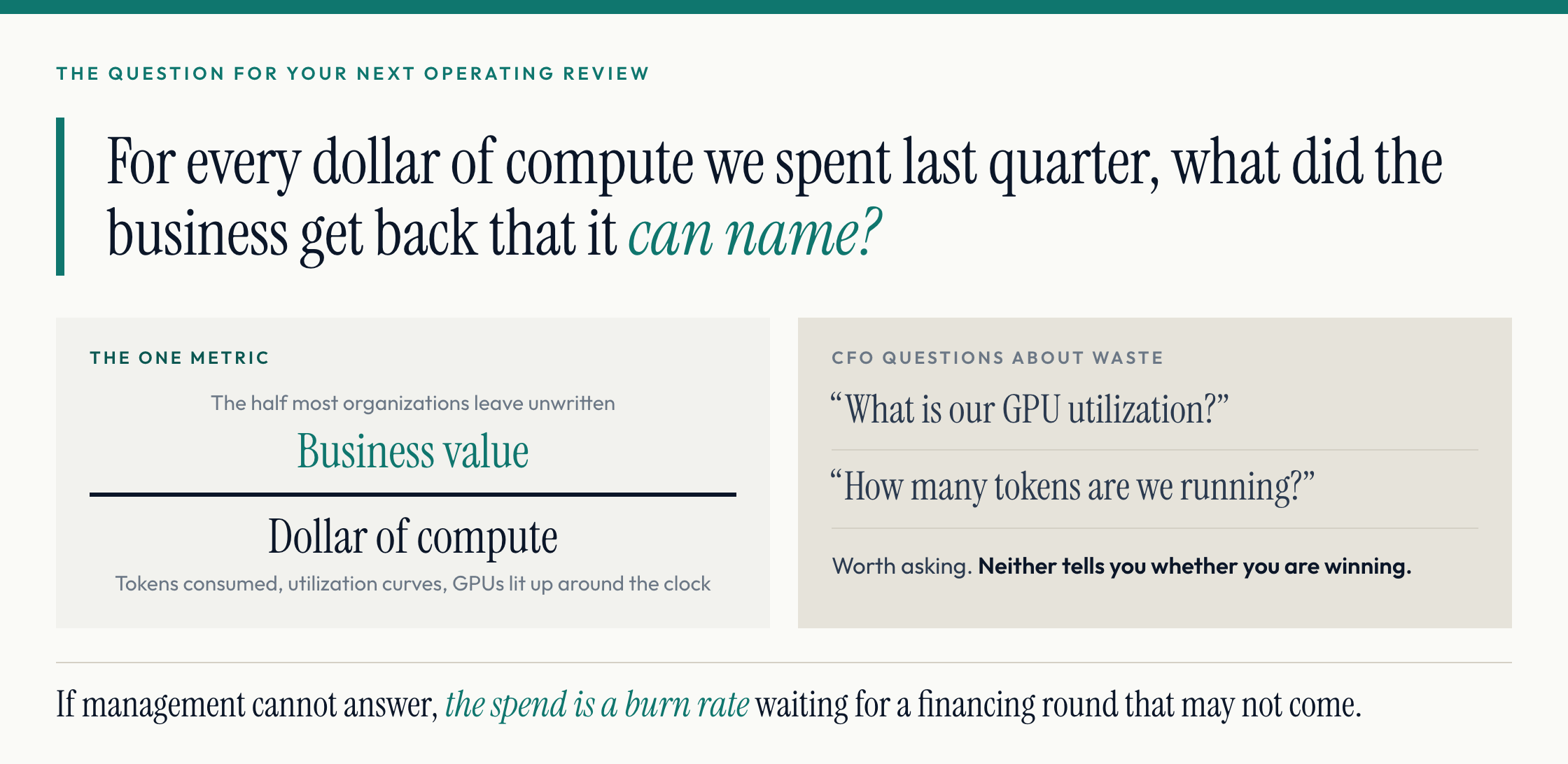
The winning formula was never more compute, and it was never even efficient compute. It is business value per dollar of compute. That is the metric. Everything else, tokens consumed, utilization curves, GPUs lit up around the clock, is the cost side of a ratio that most organizations have only half-written.
For a board or an executive making the call right now, the question to bring into the next operating review is not “what is our GPU utilization,” and it is not “how many tokens are we running.” Those are CFO questions about waste. Worth asking, but they do not tell you whether you are winning. The question that tells you whether you are winning is this: for every dollar of compute we spent last quarter, what did the business get back that it can name? If management cannot answer, the spend is not a strategy. It is a burn rate waiting for a financing round that may not come.
This is not a lone view from the cheap seats. Orlando Bravo, whose firm has bought more enterprise software than almost any investor alive, drew the same line in a Bloomberg interview from Berlin. The companies struggling right now, he argued, are not struggling because of AI. They forgot to innovate. They forgot that domain expertise matters. He called it a management story, not a technology story. Bravo is bullish where I am cautious, and he talks that book for a living. But on the one thing that sorts winners from losers, we land in the same place.
I have watched this resolve before. When the dotcom money stopped, the companies that had treated spending as proof of progress wrote the layoff lists, and some did not survive to write them. When the cloud bills came due a decade later, the reckoning was quieter, but the sorting was the same: the organizations that could tie spend to output kept their budgets, and the ones that could not had them cut. The technology was never the question. The discipline was.
The same sorting is coming for AI. The only thing left to decide is which side of it you want your name on.
Sources
- Framtidsfabriken (Framfab) history, IPO, valuation, and collapse — Internetmuseum, Swedish Internet Foundation. https://internetmuseum.se/tidslinjen/framfab/
- “The GenAI Divide: State of AI in Business 2025” — MIT Project NANDA (July 2025); coverage via Fortune. https://fortune.com/2025/08/18/mit-report-95-percent-generative-ai-pilots-at-companies-failing-cfo/
- Uber’s 2026 AI budget, Claude Code rollout, and adoption figures — Forbes (May 2026). https://www.forbes.com/sites/janakirammsv/2026/05/17/uber-burns-its-2026-ai-budget-in-four-months-on-claude-code/
- Uber COO Andrew Macdonald on the value link (“that link is not there yet”) — Fortune (May 2026). https://fortune.com/2026/05/26/uber-coo-ai-spending-tokens-claude-code/
- Amazon’s “KiroRank” leaderboard and shutdown — Financial Times (May 2026); coverage via AI Magazine. https://aimagazine.com/news/why-amazon-has-dropped-its-internal-ai-usage-leaderboard
- Meta CTO Andrew Bosworth, Nvidia CEO Jensen Huang, and Databricks on token spending — Forbes (March 2026). https://www.forbes.com/sites/richardnieva/2026/03/31/the-ai-gods-spending-as-much-as-they-can-on-ai-tokens/
- Meta capping internal token spend; Bosworth’s reversal — Fortune (April 2026). https://fortune.com/2026/04/09/meta-killed-employee-ai-token-dashboard/
- Reported $500M single-month Claude bill (unconfirmed, unnamed client) — Axios, via Tom’s Hardware. https://www.tomshardware.com/tech-industry/artificial-intelligence/mystery-company-accidentally-blew-usd500-million-on-claude-in-a-single-month-failed-to-put-usage-limit-on-licenses-for-employees
- Annual Economic Report 2026 (June 28, 2026) and Bulletin No. 120 — Bank for International Settlements. https://www.bis.org/publ/arpdf/ar2026e1.htm — https://www.bis.org/publ/bisbull120.pdf
- Hyperscaler 2026 capex above $600B — Introl (January 2026). https://introl.com/blog/hyperscaler-capex-600b-2026-ai-infrastructure-debt-january-2026
- Capex intensity (34% of revenue) and free cash flow turning negative — Allianz Research (March 2026). https://www.allianz.com/content/dam/onemarketing/azcom/Allianz_com/economic-research/publications/specials/en/2026/march/2026_03_25_AI.pdf
- AI capex as a share of GDP (0.8% vs historical peaks) — Goldman Sachs Research (December 2025). https://www.goldmansachs.com/insights/articles/why-ai-companies-may-invest-more-than-500-billion-in-2026
- Orlando Bravo (Thoma Bravo) on struggling companies facing a management problem, not an AI problem — Bloomberg interview. https://www.youtube.com/watch?v=MLDhsPCtAHA