Resource
Open weights is not open source.
Llama is not open source. Neither is DeepSeek-R1, and for a completely different reason. Until May, there was no authority you could point at to settle which of those two objections was the real one.
On 29 May 2026 the G7 Digital and Technology Ministers approved a Vision on AI openness opportunities and shared language, developed with the Open Source Initiative over a three-month partnership. It is a non-binding reference document, three pages long, and it does something the argument has needed for two years: it says what the words mean.
The document sets out four principles and a four-tier typology. The principle that carries the most weight is the second one — openness is not binary, it is a spectrum — and the third names the components that spectrum runs across: use restrictions, model weights, deployment code, training code, and training data. Five things. Most releases ship two of them.
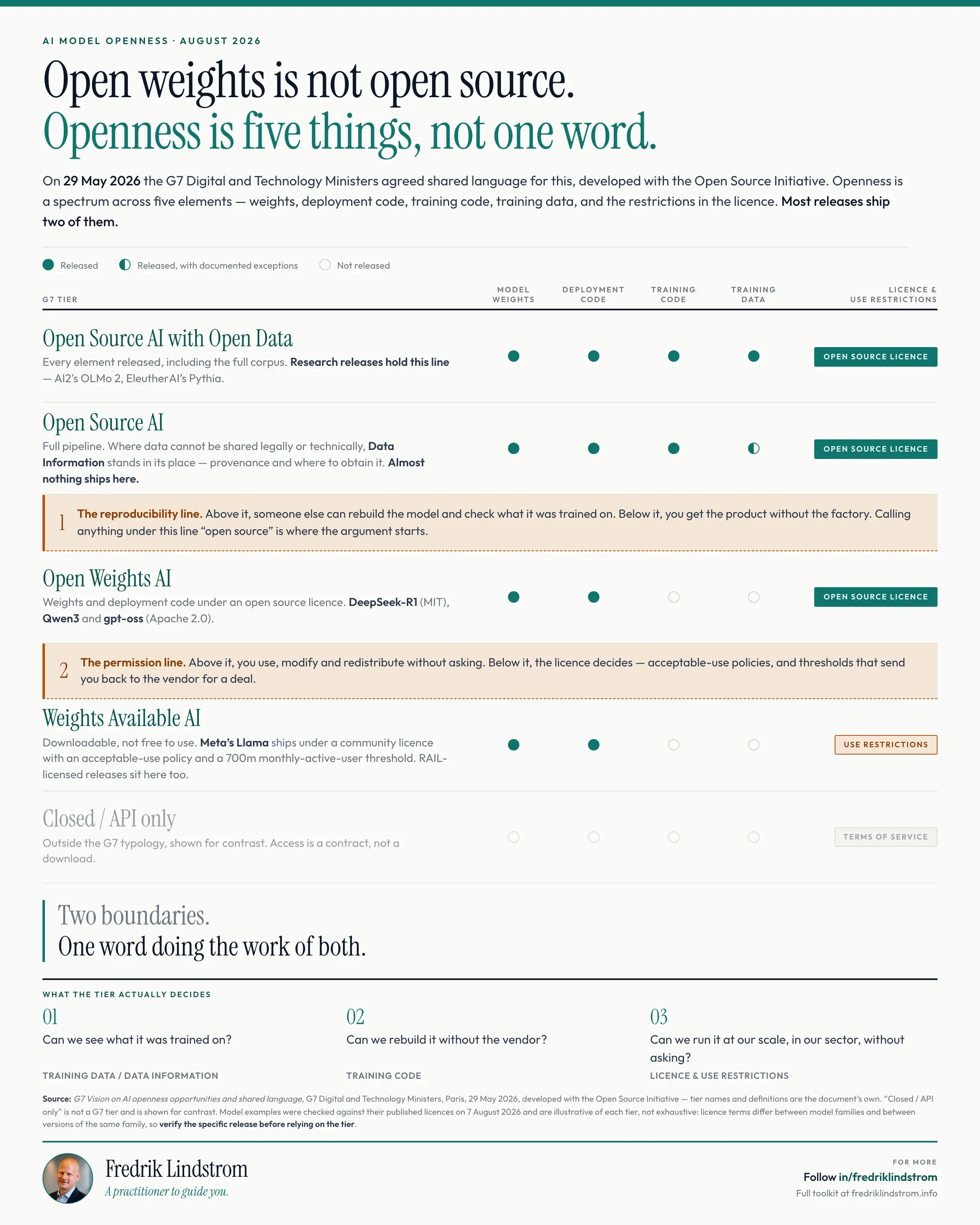
The four tiers, most open first
Open source licence Use restrictions
-
Open source licence
Open Source AI with Open Data
Weights · Deployment code · Training code · Full training data
Every element released, including the full corpus. Research releases hold this line — AI2’s OLMo 2 ships Apache 2.0 weights, its training code, and the OLMo-Mix and Dolmino-Mix datasets; EleutherAI’s Pythia ships Apache 2.0 weights, the GPT-NeoX training code, and the Pile.
-
Open source licence
Open Source AI
Weights · Deployment code · Training code · Training data, with documented exceptions
The full pipeline, with one carve-out. Where training data cannot be shared legally or technically, the G7 asks for Data Information in its place: what the data was, where it came from, how it was filtered, and where to obtain the parts that are obtainable. Almost nothing ships here.
-
Open source licence
Open Weights AI
Weights · Deployment code
Weights and the code to run them, under a real open source licence, with the training code and data withheld. DeepSeek-R1 is MIT. Qwen3 and gpt-oss are Apache 2.0. You can use, modify and redistribute these freely. You cannot rebuild them, and you cannot audit what they were trained on.
-
Use restrictions
Weights Available AI
Weights · Deployment code
The same two components, under a licence that restricts how you may use them. Meta’s Llama ships under a community licence carrying an acceptable-use policy and a 700m monthly-active-user threshold above which you go back to Meta for terms. RAIL-licensed releases sit here too, with field-of-use limits.
A fifth row appears on the matrix for contrast and is not a G7 tier: closed, API-only models, where access is a contract rather than a download. The typology stops at Weights Available because it is a typology of openness, and a model you cannot download is not on that spectrum at all.
Two boundaries, one word
The reason the open-source argument never resolves is that people are arguing across two different boundaries at the same time, and both of them are real. One person means the licence is restrictive. Another means the pipeline is closed. A two-box open-versus-closed diagram forces those into the same fight. They are separate claims, they sit at different points in the stack, and each can be true while the other is false.
- 1
The reproducibility line
Between Open Source AI and Open Weights AI
Above it, someone else can rebuild the model and check what it was trained on. Below it, you get the product without the factory. This is the line people mean when they say Apache-licensed weights still are not open source, and on the G7 typology they are right — the licence is open, the pipeline is not.
- 2
The permission line
Between Open Weights AI and Weights Available AI
Above it, you use, modify and redistribute without asking. Below it, the licence decides. This is the line people mean when they say Llama is not open source, and on the G7 typology they are also right — for a completely different reason, on a different component, at a different point in the stack.
Two boundaries. One word doing the work of both.
What the tier actually decides
The taxonomy is not the point. The point is that a tier is a shorthand for three questions a procurement review has to answer anyway, and the tier answers all three at once. A review that stops at “it’s open” has not answered any of them.
- 01
Can we see what it was trained on?
Training data, or the Data Information that stands in for it. Decides whether you can answer a regulator asking what went into the model.
- 02
Can we rebuild it without the vendor?
Training code. Decides what happens when the vendor deprecates the version you built on.
- 03
Can we run it at our scale, in our sector, without asking?
Licence and use restrictions. Decides whether growth or a change of use sends you back to the vendor for a deal.
The governance consequence is narrower than the taxonomy and worth stating on its own. A model in the Weights Available tier carries terms that survive the procurement conversation, and the label on the launch blog does not change them. A user threshold is a clause that fires on your growth, not on your intent. If the business case assumes you can run the model at ten times current volume, someone has to have read the clause that says whether you can.
Sourcing, and one caveat that matters
Tier names and definitions on the matrix are the G7 document’s own, taken from the typology on its third page. The G7 defines Open Weights AI as AI released free of charge with its weights and deployment code, under an open source licence. Everything the matrix adds is the component scoring and the two boundary annotations.
Verify the release, not the family. Model examples were checked against their published licences on 7 August 2026. They are illustrative, not exhaustive, and licence terms move between model families and between versions of the same family. Qwen is the proof: Qwen3 is Apache 2.0 and belongs in Open Weights, but earlier Qwen generations shipped under a custom licence carrying a 100m monthly-active-user threshold, which is a Weights Available tier, and Qwen-Max is API-only. The examples on this matrix are version-pinned for that reason. Yours should be too.
One more, for anyone checking this work: the Open Source Initiative’s own blog summary of the G7 vision collapses the four tiers into three and folds the Open Source AI definition into Open Weights. The ministerial document is the source of record.
Source: G7 Vision on AI openness opportunities and shared language,
approved by G7 Digital and Technology Ministers, Paris, 29 May 2026, developed with
the Open Source Initiative. Licence checks: Hugging Face model cards for
allenai/OLMo-2-1124-13B, EleutherAI/pythia-12b,
deepseek-ai/DeepSeek-R1, openai/gpt-oss-120b and
Qwen/Qwen3-235B-A22B, and the Llama community licence, all read
7 August 2026. The component scoring and the two boundary annotations are this
page’s reading of the typology, not the G7’s framing.
Related
What each AI tier actually decides — the other tier chart, on a different axis: regulatory exposure against the consequence of the decision, with the reversibility column most charts leave off.
The agent halt matrix — the same move applied to agents. A capability checklist grades one axis and leaves off the one that decides who is accountable.
The Governance Memo carries this work monthly for boards and CISOs — one breach post-mortem and two or three governance items.