Resource
A Venn diagram is a claim about overlap.
The shape promises to show you where the domains meet. Then every item is placed inside a circle.
Data governance, AI governance, AI security, AI ethics and compliance, drawn as four overlapping circles carrying sixty-odd items between them. The individual contents are accurate and are not the objection. The objection is structural, and it applies to the genre rather than to any one author: a diagram whose form promises intersections and whose content contains none.
It is worth being precise about why that matters. A Venn is chosen over four lists for exactly one reason, which is to say something about the overlaps. Leaving them empty is not a stylistic choice. It is declining to answer the question the diagram raised.
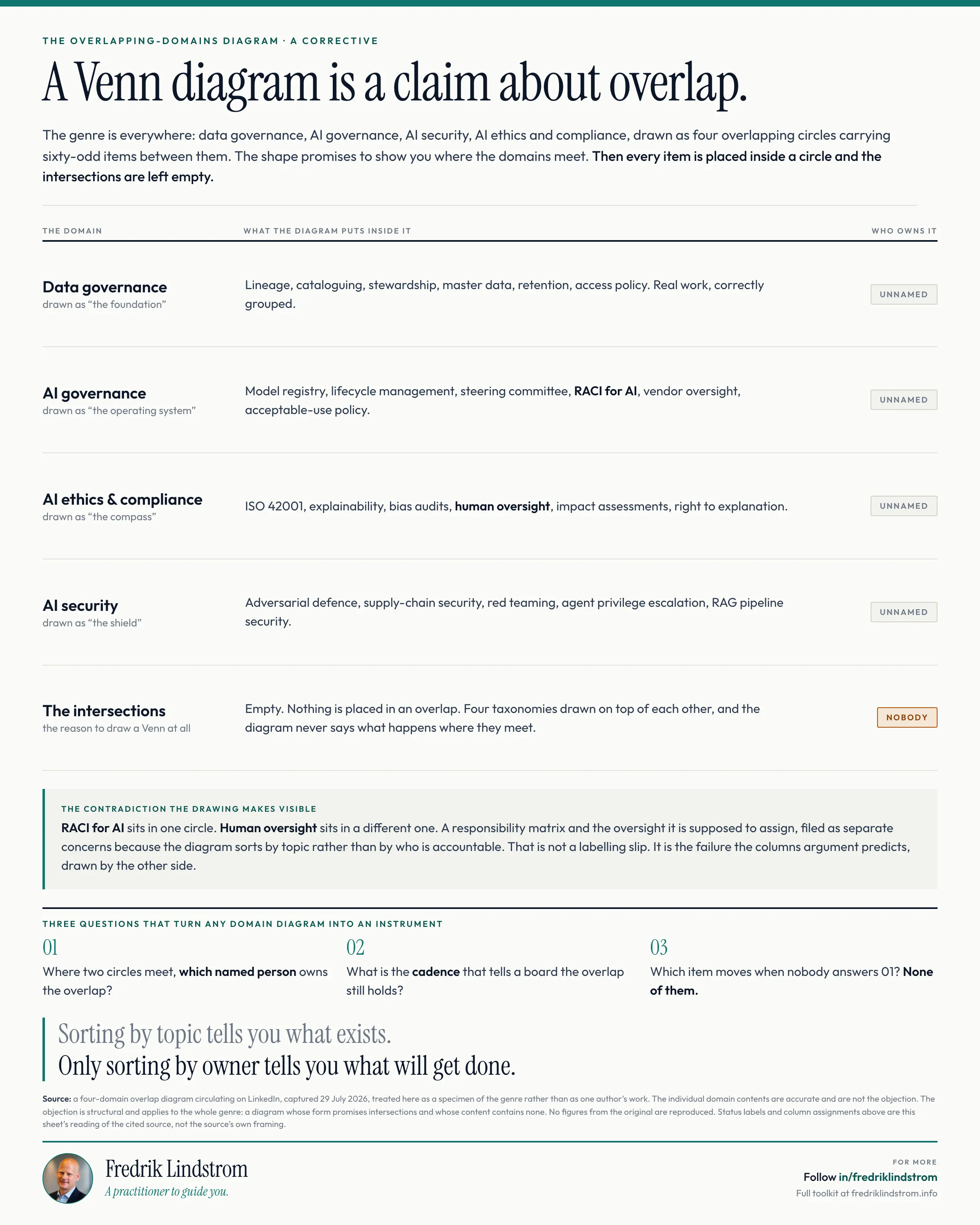
Four domains, and the question none of them answers
-
Unnamed
Data governance
Lineage, cataloguing, stewardship, master data, retention, access policy. Real work, correctly grouped.
-
Unnamed
AI governance
Model registry, lifecycle management, steering committee, RACI for AI, vendor oversight, acceptable-use policy.
-
Unnamed
AI ethics & compliance
ISO 42001, explainability, bias audits, human oversight, impact assessments, right to explanation.
-
Unnamed
AI security
Adversarial defence, supply-chain security, red teaming, agent privilege escalation, RAG pipeline security.
-
Nobody
The intersections
Empty. Nothing is placed in an overlap. Four taxonomies drawn on top of each other, and the diagram never says what happens where they meet.
The clearest tell is internal to the drawing. A responsibility matrix sits in one circle and the human oversight it is supposed to assign sits in another, filed as separate concerns because the diagram sorts by topic rather than by who is accountable. Sorting by topic tells you what exists. Only sorting by owner tells you what will get done.
Three questions that turn any domain diagram into an instrument
- 01
Where two circles meet, which named person owns the overlap?
- 02
What is the cadence that tells a board the overlap still holds?
- 03
Which item moves when nobody answers 01? None of them.
Sorting by topic tells you what exists. Only sorting by owner tells you what will get done.
Source: a four-domain overlap diagram circulating on LinkedIn, captured 29 July 2026, treated here as a specimen of the genre rather than as one author’s work. The individual domain contents are accurate and are not the objection. The objection is structural and applies to the whole genre: a diagram whose form promises intersections and whose content contains none. No figures from the original are reproduced. Status labels and column assignments above are this sheet’s reading of the cited source, not the source’s own framing.
Related
The agent halt matrix — capability checklists grade agents on one axis and leave off the one that decides who is accountable.
What each AI tier actually decides — regulatory exposure tracked against the consequence of the decision, with the reversibility column most charts leave off.
The Governance Memo carries this work monthly for boards and CISOs — one breach post-mortem and two or three governance items.